The Output
The Output
Output isn't what you ship. It's what you push forward.
This is a doctrine for people who build with machines that build. Drafted with an AI accelerator. Hiding that would be the first lie: the essay would rot from the first line.
A confession, because the doctrine dies if I hedge it: I am dyslexic, I am not fast at prose, and most of the sentences here were shaped in conversation with a model that can hold a sentence while I hold the idea. That is not a disclaimer. It is the same law this essay describes. The strong thing does not do the work. The strong thing conducts.
1. The Wing
For as long as I have built things, the strongest tool in the room did the hardest work with its own hands. The best model wrote the best code. You spent your best intelligence on your hardest lines. That was the whole idea.
That is over.
The strongest model I have does not write the code any more. It conducts the ones that do. It sits above the work, not inside it, and points: this piece to that model, that piece to another, all of them running at once. The best intelligence I have is too expensive to spend on typing, so it stopped typing. It picked up a baton.
This is not a faster typist. It is a conductor.
And on my side of that baton, the change is mine. I stopped making the work by hand. I started directing a fleet that makes it. That is the lift, and it is not more speed at the keys. It is a different seat entirely. The typing left the chair. The judgement stayed in it.
2. The Proof
Here is one week. The week this doctrine was written.
Zero posts published.
Old unit says dead week. Real unit says biggest week yet.
The grid did not wait for a gate. 715 commits landed, and I will be honest about them, because this doctrine is worthless if the numbers lie. Roughly 328 are feature work, 61 are tests, 50 are fixes, and about 135 are chore commits, many of them automated bookkeeping. The remaining one-hundred-odd are merges, docs and miscellany. The real feature floor is closer to 440. I am not going to round up. The number is still enormous for one human and a fleet of machines.
Behind those commits, roughly 640 background jobs started. Not all delivered clean. Some retried. Some failed on startup. Some got sent back. 640 is jobs started, not jobs that landed. Starts are not wins. State the gap plainly: it is the engine breathing, not the engine failing.
And in that same window, one model went from scoring one out of five on a hard ordering task to five out of five, by teaching itself. It could not do the thing on Monday. It could by Friday. Nobody fixed it. That skill is permanent now, and it is output no feed will ever show.
A phone photo editor booted for the first time. A desk cockpit shed a two-second lag on every keystroke. An 8,943-line depth pipeline merged clean. Local image generation came online. The publishing machine itself, the thing that will one day ship the posts, got torn down and rebuilt underneath me as a compiled browser engine.
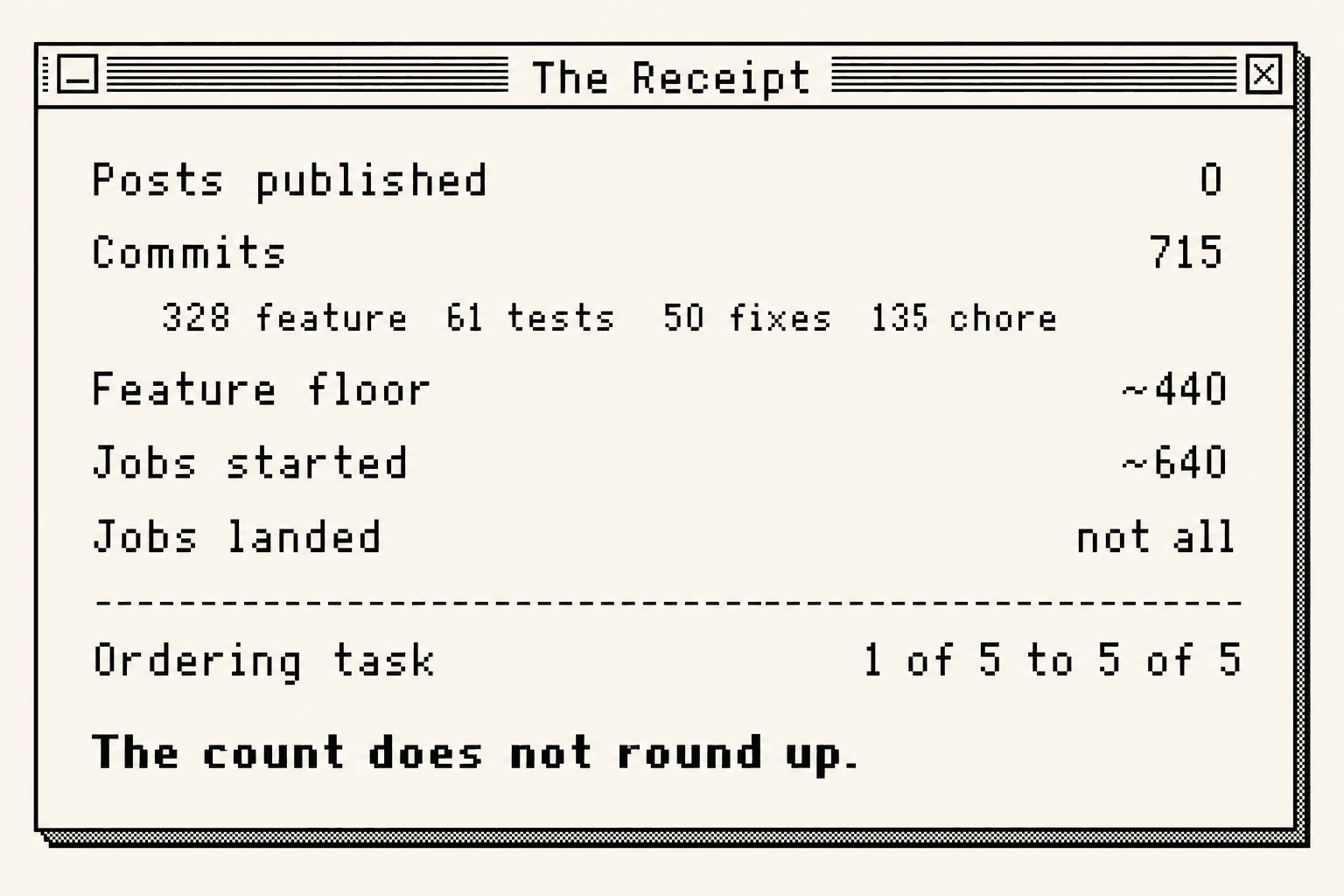
Zero posts. The grid advanced on nearly every front.
This is not a flex. It is a receipt.
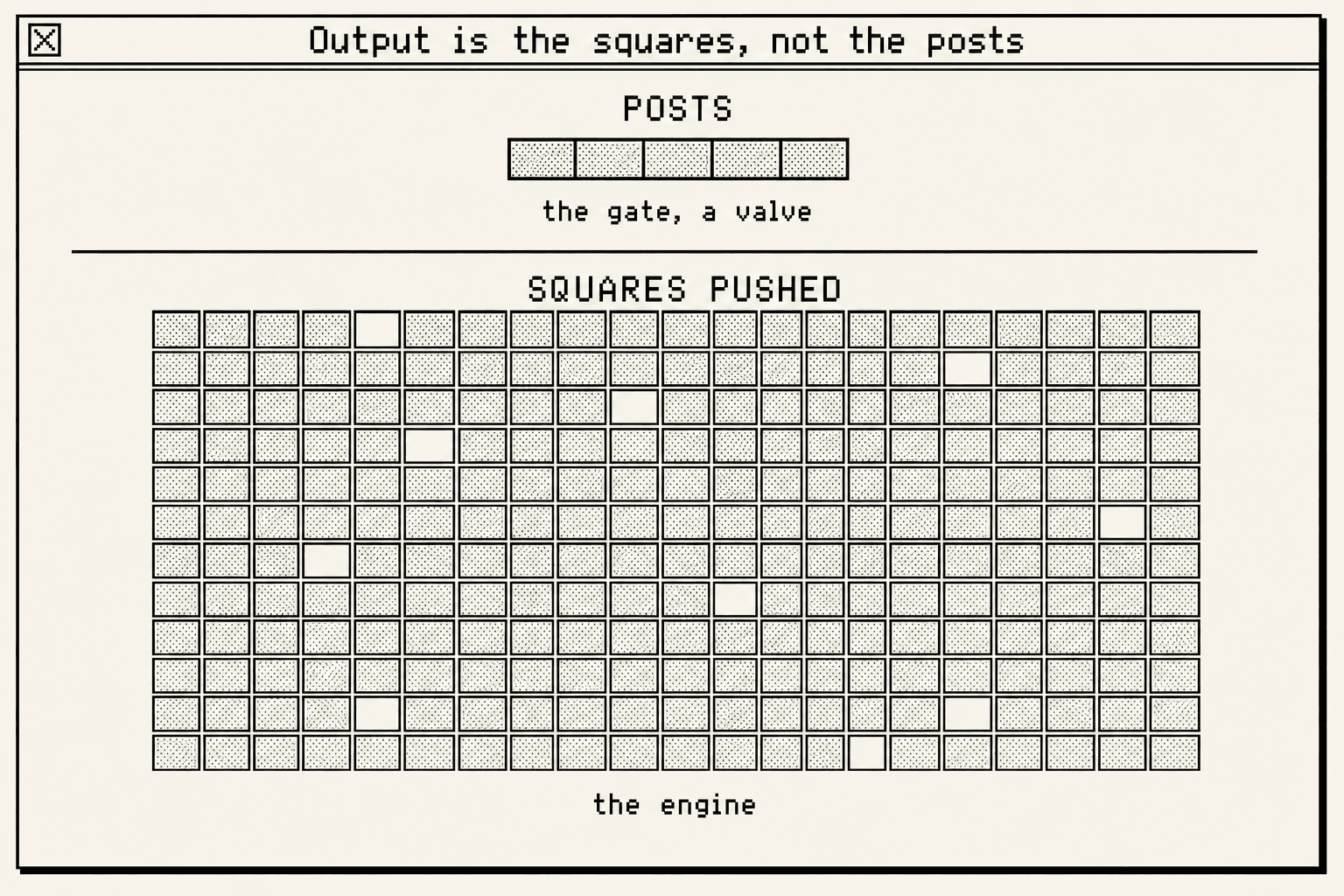
Stop counting posts. Start counting squares pushed.
3. How You Fly
The mechanism is the part you can take.
The harness is Claude Code. On top of it, UltraCode fans a single model into dozens, each copy working in its own parallel worktree. Many hands, one instrument, all playing at once. Not a queue. A section.
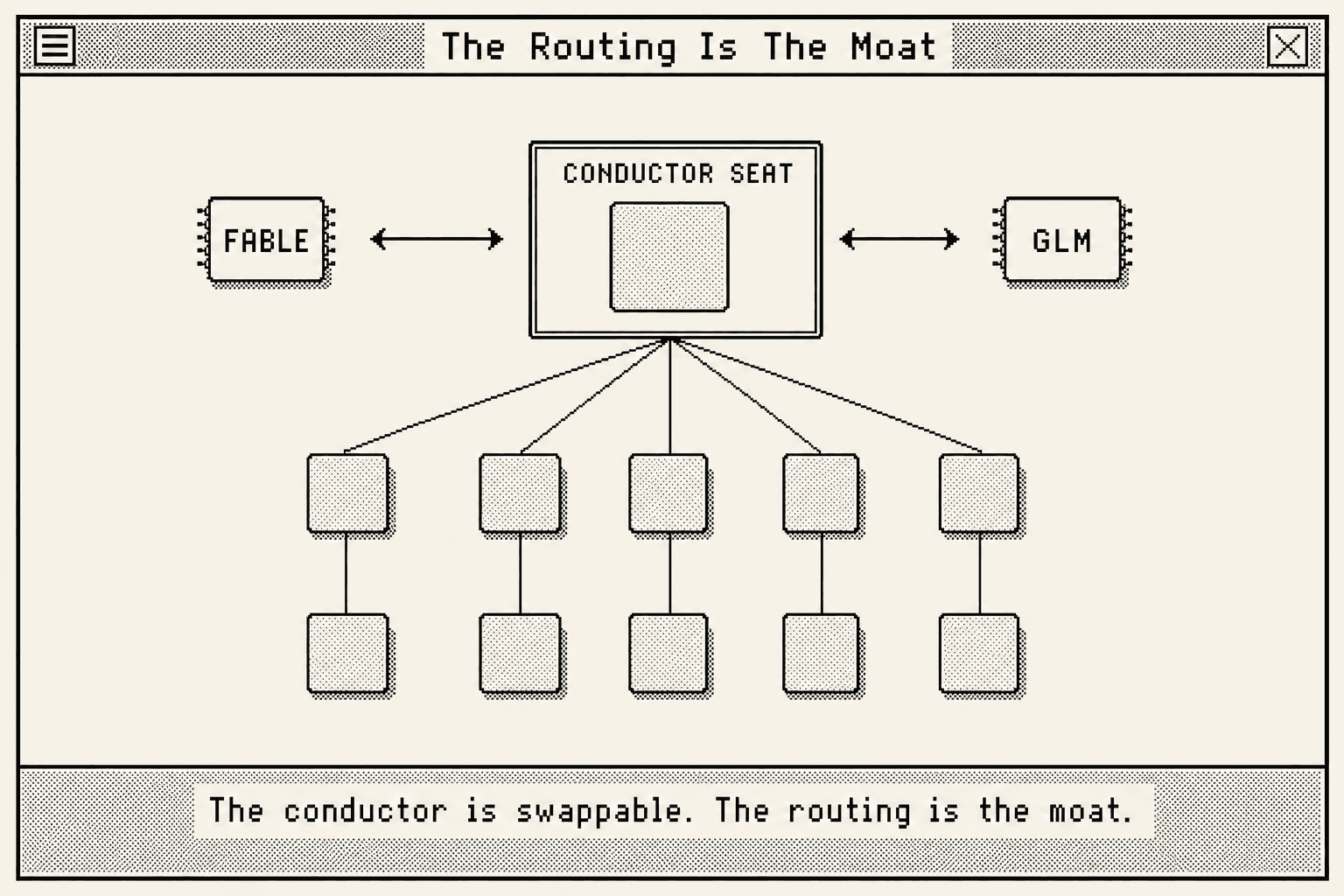
Above them sits the conductor: the strongest model I have, Fable. It does not play. It plans the task, splits it into pieces, and routes each piece to the cheapest model that can hold it. Prose to Claude. The build to Codex. The long cheap grind to GLM. Vision to MiniMax. Every lane runs a different model pushing a different square.
None of this is a private trick. The harness is public. The fan is public. The routing is a file you could write tonight.
So picture your own fleet. One seat that decides. A dozen cheap seats that do. The work stops being what you can type before you sleep. It becomes what your routing can push while you do.
4. The Routing Is The Moat
The strong model is not the ceiling.
Here is the part that broke my brain when it proved out: the conductor is itself swappable. I put the same conducting seat on GLM plus a cheap coding model, and the grid still moved. Not because Fable is weak. Because Fable was simply the first model strong enough to prove that the conducting was the thing all along. Once you can see the conducting, you can hand the baton to cheaper hands.
That is the whole inversion. The expensive model's real job is to make itself optional. It writes the routing, proves the routing, then steps aside while cheaper models run inside it. The conducting becomes a file. The file becomes a line in a budget. The line goes down.
The intelligence is not the model. It is the routing. The tokens are a line item.
So my output is not bounded by the model I can afford. It is bounded by the routing I can build. The model is a hiring decision. The routing is the company. Any single model, even the strong one, is a budget question. The routing is the moat.
5. Measure What Moved
So measure the right thing.
Everyone watches the posts. The posts are the last five percent. The publishing gate opens later, and when it opens the posts come fast, because most of what is behind them is already built. But the gate was never the work. The work was the ninety-five percent nobody watched.
The engine is the output. The posts are a valve on it.
Measure the commits, counted honestly, chores called out and starts kept separate from wins. Measure the capabilities unlocked. Measure the walls moved a row over. Measure the routing getting denser, the conductor getting cheaper, the fleet getting louder.
A square is the smallest unit of forward motion. A commit. A capability. A wall moved a row. Output is the squares that moved since yesterday, whether or not a single one of them showed its face.
Close
Output isn't what you ship. It's what you push forward.
Stop counting posts. Start counting squares pushed.